
first aid
skylar lynn tibbetts
I
HERE I AM, writing in blue, probably because I’m alone for the first time in what feels like a long stand. I spent the day in the fire station up near the pass, devising wilderness survival scenarios, contemplating physical trauma, and learning how to save you—or anyone else for that matter, but you and I were often barely escaping accident. I wonder how the day looks when you’re just focused on it, rather than somewhere down the hill. Every pen I have is out of ink and so I am forced to use one so thick-tipped. I was saying last night how I’m unsure how to be someone I like. Or if not so boldly inspired, at least someone I don’t care enough to judge. Later I’ll hate myself for speaking in non sequiturs, but presently I feel as if the moment is so blindly about me that it’s worth any resulting strain. I’m aware that I’m behaving selfishly here, although in fairness it was not even ten months ago that you convinced me it was all the time actually and on that note ended everything.
II
THE LAST I HEAR: I’m packing up to leave and I feel ready to close this chapter with you. I wish you the best on your healing journey. Sam says this is basically the equivalent of: I feel ready to be done hitting you with my car. I wish you the best on healing from me hitting you with my car. I really wish I had been run over because that seems easier than this long-draw. I’ve been in the hospital at least; I’ve never before been in such a loose state of trouble. Imagine instead that you’d taken the high road and did hit me with your car, the impact leaving me with some deep, pulsing wound: a torn-open extremity oddly intimate in its seething possibility, thick with blood and gushing. With more strength I might pressure stop the bleeding. Yet the incision, in its opening, in some defenselessly life-altering way, transforms, and becomes portal. [Portal being both entrance and exit / its perspective entirely dependent on desire.] I am the inside of my own body. I am skin and guts and I am muscle. But am I clear? You’ve made a certain monster out of me and I must remind myself I am no creature other than bones and blood.
III
WHAT HAPPENED TO ME is not even entirely interesting. To be so blatant feels either pitying or stylistically misplaced. I hate to get the point across. For my own sake, let us use the hypothetical:
Headed east for summer, the girl bid her adieu. To the lofty house on north campus—in the town so near to the border that it verges on Canada—and to her roommates—those four girls closer to her than even herself. Upstairs, the bedrooms, clustered around a single bathroom, where unless you were taking a shit (and sometimes even if you were), the door was always left open. Strangely, the house had two front doors situated directly beside each other, leading into the same common room. For this characteristic the house was dubbed ‘Door Door,’ and although the girls only ever used the left one, the parallel entryways evoke an illusion of detachment, a splinter running straight down the middle of the house. [Remember: an omen is only an omen if established.]
It’s not long till it’s clear. Whether it had been previously decided or like an epiphany once she’d gone, it did not matter. Oh, and with no explanation, the four of them against her and no point trying to reconcile, or even make sense of, cuz we’d like never to be contacted by you again.
Enough. Obviously the desolate girl is me, and you, my love, are one of them—which, speaking of ‘the point’, is just that.
IV
REALLY THIS ALL SEEMS LIKE A BIG JOKE and I find myself completely taken with it. I think of the river, the little girl a few summers ago who fell out above the dam and her dad who jumped in after her. I know never to get in the water after anyone, because that’s two people in the river rather than one and how they got to the girl but not to her dad and he went right over the hydraulic, his body flushed out a day later. Every one of us are heroes when we’re dead. But I’m speaking for myself, how my death is only essentially.
V
WHEN I’M ON THE RIVER I usually carry Jim Harrison’s Selected Poems, although as of late it’s been Eve Babitz, Slow Days, Fast Company. In fact Babitz writes like Harrison if he was a pretty Jewish girl in LA: those long winding sentences that, just when you’ve given up on finding the turn, hit you right in the gut with some catharsis or another. Or perhaps the other way around: Eve a Midwestern alcoholic who fished in rivers and whose God was Nature with a gun and a bottle of whiskey. This body we’re born into being just about the whole lot.
VI
I DIDN’T THINK I’D TELL YOU I loved you in the canyon, but something about the place brought about a vulnerability that, once faced, left me incapable of being anything but exactly what I was.
VII
THERE WAS THE SUMMER I WAS ON BEDREST and committed myself to reading as many “classics” as I could. This was just months after officially declaring myself an English major which I did and never reconsidered. To feel so certain about something would be few and far between in my life. Those months saw me in bed with a broken back and you in the desert, obsessively studying pictographs, camping in a cave for the night, bringing with you four tabs of acid and calling it your Vision Quest. I only did LSD once and the whole experience was so contrived I felt it had almost nothing to do with me.
VIII
YOU’RE IN THE SHOWER and I’m knees-up on the countertop: joint in one hand, some book in the other. Next it’ll be my turn, and you’ll read aloud to me as I lather my body in soap and run my fingers through my thick hair. Those nights, eyeing your naked body when you were distracted and unaware of my looking. Did you do the same for me? I was betrayed, and I’ve moved, but not really on.
IX
I AM MORE PESSIMISTIC THAN EVER BEFORE, having never had any such business happen to me. At times it feels like you left simply to put me through something. How can someone who cares so deeply for you in one time, hurt you so masterly in the next? I suppose the answer is in the question. To realize your queerness by falling in love with your best friend is too overdone to be romantic and too naive to last, but still earnest enough to break you basically in half.
X
TODAY IS YOUR BIRTHDAY and I’m trying not to think of it. The solstice, how long and bright the day feels. It should rain tomorrow, this summer. Occasionally, I have to remind myself the Earth is dying cuz I look around and see life everywhere. Dying is still life, dead is not.
XI
TO EMBRACE YOU, TO SAY NOTHING. In that house on the plains, Montana, so deep in the country that everything is rough and yellow, and sparkles with light. Were you not my sister? My half? Were you not my wife for some time? Maggie Nelson writes on the loss of relationship, “Falling out of a story hurts. But it’s nothing compared to the loss of an actual person, the loss of all the bright details that make up a person. All the flashing, radiant fragments that constitute an affair, or a love.” The last time we spoke: when you did not want to talk with me but I forced you to hear me out, and then all I did was cry and cry, only to muster between sobs, I hate you, I hate you all. How you touched my shoulder, stuttered a quiet, I know.
XII
I SAW SID FOR A BEER TONIGHT after falling off my bike. Although I was, more accurately, flung from my bike, landing in a bed of ferns. It was determined I must’ve braked too hard going into the turn and while my helmet and knee-pads took the brunt of the impact, the strength of my emotional response surprised me and once I started crying it was difficult to stop. In any case the fall had me feeling roused and incapable of the kind of intentional restraint I’d become so accustomed to after apparently offending everyone in my life.
I tell Sid that so much of modern relationships is the projection of one’s own insecurities and traumas, the useful other as a substitution to being self-critical and perhaps in the most devastating case, wrong. Sid tells me that you’re back to living in the old house, in a long-distance polyamorous relationship, which I say sounds like hell. It’s possible I don’t know you well enough at the moment to make such a declaration, but also.
XIII
THAT LONG-AGO SUMMER, the pain had been bad until it was worse. It must’ve been the next morning, after the boat turned sideways and I braced for impact, that I stepped out of bed and crumpled straight to the floor. The surgeon’s office is closed on weekends and because I am capable of speaking on the phone, I’m deemed too lucid for an emergency case. Except when they see me Monday I’m all pretzeled up, a desperate girl, unraveling myself only for the doctor and his identical student. I am woman and I am to be always excellent, in spite of my body. From now on, my mother says, you will be raw and uncompromising.
XIV
I WISH YOU’D HAD THE DECENCY to let us scream at one another. Maybe I’ll change my handwriting again and wouldn’t you just hate me for it—telling me I’m not special whatever chance you got. At the dinner table, even, that night my trip got canceled and you knew I was anxious and there was nothing I could do but mope around and make everyone else feel equally terrible. Now we’re states away and it can’t be realized.
Really it’s that my head has hurt continuously for the whole day—and damn, if Reneta Adler can write a book like Pitch Dark then maybe so can I. First of all, it doesn’t have to be popular, I just have to like it. Celebrity is so twisted nowadays anyway. Whenever I have a headache this painful I pick up Krishnamurti’s Notebook in hopes that I, too, can find something so articulate, so concise, in severe, debilitating pain.
XV
THERE COMES THE REALIZATION that no matter how close, we are not the river. The raft perched on the surface and your loose shirt slumped over the bow, pulled then by the wind into the water and I jump in clawing after it, body stuck in the seam as the low current grabs the shirt and sucks it down down until my floating person, stomach on the face, arms outstretched towards the depths and thinking, It takes but it gives it gives it gives.
XVI
AT HOME WE’D SMOKE INSIDE, sitting on the floor under the window in either of our rooms, smoke billowing to the ceiling and dissipating. But out there, hundreds of miles away, in the cold of March, the winds too strong to light up, we held the flame deep between our bodies, leaning into one another to create a barrier of flesh and bone. In the dark, crawling beneath the sheets in our underwear, your arm sliding over me and under my shirt, hunting for warmth. It’s a comfort, not a passion.
XVII
THAT PRECIOUS NIGHT ON THE BOAT left me further broken and I missed the pain before it. I missed the pain! What a wretched thought! Leaving me feeling quite wasteful of any time I spent brooding about my situation, soaking in my own splintered body, deaf to the range of my pain. Convulsing in turns through the long weekend, barely feeling relief from the oxycodone, the methocarbamol, all I can stomach in the meantime of this endless showdown with my fractured self.
XVIII
THERE’S THE RIVER AND THEN THERE’S OUTSIDE IT. It was intentional the first time I really swam a rapid—the group of us hiking however far up the shore, flailing our bodies into the current and swimming madly forty-five degrees upstream to make it to the middle before the river narrowed. In this case: two rock pilings on either bank, constricting the torrent into a tight channel to form a near-perfect wave-train. May this be why the rush of any water gives me up to my feelings, to my blubbering and my misgivings? Because they are, in essence, the same thing: an outpouring.
Feet pointed downstream and my helmet peeking out from the surface, I creep toward the rough water. Paradoxically, the section directly before a rapid is often the slowest part of the river, allowing time to contemplate what the hell I’m doing putting my body in this body—cuz this body is my body—sliding down the tongue. I tip my ear just beneath the surface and listen as the boulders lumber along the floor.
XIX
SO THE DAY IS SPENT, in the fire station up near the pass, driving back the winding way, thinking how it’s not so much the will to save you as to take a mild, delicate care of you. I had a dream last night where we had sex and it wasn’t the first time. How is it that you’re still here when you are so far away?
Was it not enough to say I would love you forever? Us, by the river and in the river. She always wants to take me down, hold me under. This is the first time I say no—move against her, so that we can stand on the shore, clutching our cold, wet bodies, and I can say that I’ll love you forever and you can look over at me, your eyes this mad and rolling water.
XX
I AM SCARED to go alone but if I do I will be brave.
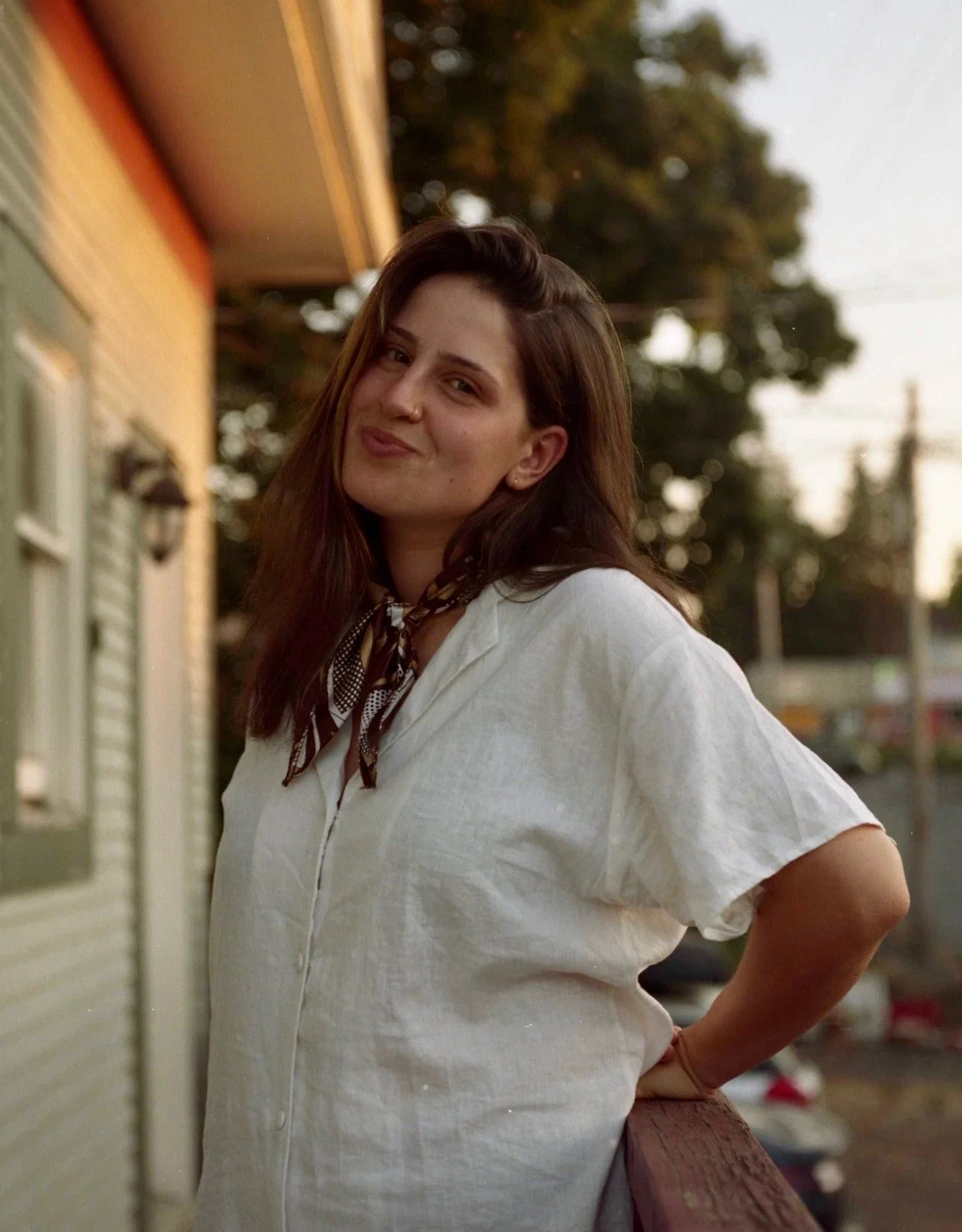
skylar lynn tibbetts
is a hybrid writer from Seattle, WA. She holds an MFA in creative nonfiction from the University of Montana. In the summers, she moonlights as a whitewater guide on rivers across the West.