
Cycles
bonnie day
I dig my nails into the wood of the windowsill until my fingers ache. There are already gouges in the paint; others have been here, at this window, waiting, wishing.
Now there is only John – behind me, on the bed, where I cannot bring myself to look.
“Mom!”
I stumble over a breath, but I can’t turn – even for her.
Her breath comes in staggered starts, and I know she stands there, beside the bed. She will be staring at him, trying to find her father under the bandages, the tubes, the beeping machines. She will search for him, as I have, but it will make no difference. He isn’t there. Not anymore.
“Mom?”
I can feel her behind me now, but I’m cold, inside and out. The words won’t come, and I cannot face her. Finally, I feel her cheek on my back; a wet patch seeps through the cotton of my blouse.
We stand there with nothing to say. Nothing but mechanical beeps and whispery puffs.
Whenever things got tough, John would pat me on the arm. “It’s time to face the music,” he’d say. Then we’d face it together – whatever it was. But there is no music here.
I take her hand, and we walk to the bed where he lies. Someone I cannot recognize. But I can see his wedding ring in twisted gold, the tiny scar above his left eye where his brother hit him with a golf club forty years ago, the left hand with its nails bitten to the quick, finger pads calloused solid from pressing into violin strings. I clench my teeth like the vice in his workshop – so tight that the pieces cannot fall apart, unless they split under the pressure, a jagged tear in the wood. I gasp them apart.
“John?” He must be in there, somewhere beneath the layers: fabric, skin, sinew, bone. They say that even in a coma a patient can sometimes hear you. “John. I’m here. It’s OK.” I stagger under the lie. I saw the doctor’s face, the unsaid words behind his words. But I can’t stop myself now that I have begun. I cannot let him go and so the words spill out of me like soap bubbles at a carwash, here for only a moment, before they disappear. “It’s warm today, I think. At least they said it was going to be nice, and I can see the sun outside the window… There was a pigeon on the lamp post – that iridescent kind that has no business looking as beautiful as it is – it’s a pigeon after all. It flew down and pecked at something on the ground. Maybe garbage. Even though there’s a garbage can right beside it. People are so inconsiderate sometimes.”
Inconsiderate. Yes. Otherwise, how could anyone leave you? How could they run you down and then drive away? I gag down the thought and return to those bubbles.
“You know, you can see the park from up here. You’ve got a nice room. Really nice. All to yourself.” I look at the empty bed across the room. There had been a woman there when we came in last night, but she’s gone now. I never found out where or why. Is she dead? Maybe they just moved her, or she got well and went home. That’s better. I can imagine her lying in her bed at home, reading a book and scratching the chin of a purring cat. Liar.
“Jenna’s here…” I reach back to pull her into my arm. Anything to break the lies seeping through my skin like tendrils of spider silk. She’s limp in my arms, but I can feel the blood in her veins. She is real, alive. I kiss her temple and breathe. “She got the flight into Toronto this morning. You must be pretty important to pull her away from Harvard law.” I can feel Jenna shudder, but I can’t look.
Jenna sniffs and leans in to take his hand. It’s daring, that touch. I’ve found it almost impossible. The limp, cool lump just laying on top of the sheet. The other hand has the intravenous drip – medicine straight to the veins, steadily pulsing through the tubing and the cannula to slide underneath the skin.
“Daddy?” She can’t seem to get anything else out and drops to her knees, head against the mattress with her hand clenching his.
We wait like that. A proper tableau with three levels, Jenna on the ground, John on the bed, me standing behind with a hand on Jenna’s shoulder. We should be in a play. It would be so much easier if we were – the portrait of a grieving family. We could stay this way, still and silent, until the lights fade and the curtain falls.
I see him then, at the door. My youngest child: boy and man melded together unsteadily, waiting for time to decide who he will be. He stands on the threshold, white and silent as a mime, guitar in hand as if ready to plead for coins on the streetcorner. He was here at the hospital last night, after the police arrived at my door, after I collapsed on the floor in the front hall, after I drove myself to the hospital, breaking any number of traffic laws. He was the adult then. But now, the child seeps through his skin like a mist.
“Mike,” Jenna says, with tears in her eyes again, or still.
He takes four steps into the room; his long, lanky limbs make short work of the distance. He sets the guitar down and stands there, awkwardly. I know that look, the one when he was six and the bed sheets were a sodden mess on the floor, guilty avoidance, darting eyes, tapping toe.
We take a seat beside the bed, scrunched together on the hard hospital couch. It’s surprising when the room dims. It must be later than I thought. The sun is below our window, but there are still some streaks of pink and orange, and the sky is a dissonance of blue and slate gray.
“Do you need anything?” A nurse comes in and watches our huddle with sympathetic eyes. When we don’t answer, she checks the chart, the machines and tubes, his hand. We all know that she will find nothing different, nothing of note. She bustles around the room and then she is gone. I suppose that she is used to silence, grief, loss. We are not.
“Can we sing?” Mike asks, as he gets up to open his guitar case. He doesn’t wait for an answer. John would be pleased, and so it is right. We are a singing family. When the words don’t come, the singing does. A little Denver, Dylan, some Clapton and Beatles. When we get to “Stand by Me,” it’s harder to sing around the lump in my throat. The night has come, and the land is dark, but I am oh, so afraid. So afraid that he will never stand beside me again. That I will be alone with the sky falling into the sea.
<><><>
We wait in a side room as the church fills. I haven’t seen them yet. All those people who wish us well, who want to make it better, but can’t.
I’m sure that I am not ready. That might be the only thing that I am sure of.
In this drab room we are alone. Jenna, Mike, me. That’s all.
I’d like to think that John is here too, like a ghostly whisper in the glance of broken light through stained glass. Maybe he straightens Mike’s tie, just like he used to do, or strokes Jenna’s hair. Was he there when I reached back to pull up my zipper? Was he standing behind me, ready to help? If he was, I didn’t feel it. I wish I had. I wish I could feel him there now. But I don’t.
“Are you ready?” The minister waits until I nod and then he takes my hand to help me rise. It feels clammy and once I’m up, I drop his fingers. We form our line with me at the back, the last, alone. Is this how it will be from here on? One step behind? Empty?
The minister nods and our procession begins. Up the aisle, past all the faces, the black and navy suits and dresses. For a second it feels like a wedding, just a darker hue. Step by step down the church aisle toward the front, lilies overflowing silver vases, the steady beat of the piano. The hymn is wrong though. “Amazing Grace” instead of a wedding march. And when we get to the front, we turn away from the table with his picture on it and settle into the front row.
At our wedding, we both sang, but here there is only me. And I have no voice. Nothing to say. And so, it had been decided. Jenna and Mike would be my voice – they will sing the notes and the words that I can not.
Mike’s guitar waits at the side. He tunes it and tosses the strap over his shoulder. It makes me smile for just an instant – the pink and orange and teal from our trip to Panama – but it is only for an instant. Then the moment is gone. Heaviness returns like a damp fog on an autumn morning just before dawn. He should be here. He would be here if someone had only been careful, had only paid attention. This is not an accident. They call it hit and run, but that sounds far too easy, too childish. See Jane hit. See Jane run. Run, Jane, run!
I clasp my hands and bite my lip. Jenna and Mike have already begun. I missed the opening, and I won’t get it back. I won’t get him back. I shiver under my black lace sweater.
Jenna sings the song from Carousel. The one that John always loved. “You’ll Never Walk Alone.” The wind and the rain, the storm and the dark and a lark. A bird call in the darkness. Promising hope, promising that I won’t walk alone. Promising that the world is still a beautiful place. But it isn’t.
<><><>
It’s been too little and too long. More than a month of prearranged casseroles in borrowed dishes that all taste like sawdust. But today, everyone has gone. It’s just me, in this empty house, on a day where the leaves are turning, and the air has that crisp bite that nips and awakens at the same time.
They say that there are five stages of grief: denial, anger, bargaining, depression and acceptance. I’m not convinced that it is quite that simple. Perhaps the stages are more cyclical than linear. Or more like a tangled skein of yarn after the cat finds it. I swear, every morning since the accident I have woken up and reached to the left side of the bed. I am always surprised to find it empty. Then I feel that joy drain out of me, drop by drop, until I lay there, limp. There is just a hole that opens anew each morning, unravelling the careful, new stitches that form throughout each day.
Then there is the anger. I am not an angry person. And yet, each new article in the paper makes my blood boil and sends a line of ants across my skin, tiny pinprick bites from fingers to toes. At first, they just announced the accident; then they asked for witnesses, then there was a car of interest, a farmer who called 911, and a notice of the obituary and funeral. Everyone who came asked if the driver had been caught, had turned themself in to the police. They asked what I would do if there was a trial. How I would cope. Was I angry? Yes. Yes, I am angry. But it’s that cold anger that freezes you silent, cooped up inside with iron in my veins.
I’m not so sure about bargaining. I don’t think that I overtly asked for any deals – there are no deals to make. I’m an adult and I know full well that he is gone. Until my dreams. He’s there every night. And some mornings I keep my eyes closed and perhaps that is a bargain I am trying to make.
This morning, I have decided.
It’s the beginning of October, and it’s the kind of day where the blue of the sky is that bright blue of the ocean. Like when we went to Nerja, Spain and sat at a café looking out over the Mediterranean. Perfect blue. Robins’ eggs, morpho butterflies, macaws, asters and morning glory, iris and forget-me-nots all rolled into one. That’s why I know it’s time.
I put on my coat, running shoes and my gloves and I grab my bike helmet from the shelf in the garage. John’s bike is gone. Smashed and blooded. I told them to get rid of it. The spot where it belongs is empty.
I used to go out every weekend. I wish now that I had done it with John, but I didn’t. I used to say that it was my time. When I could be alone. When I could think without any interruption. I could plan, create, imagine, be. There were no expectations and no one to change my mind. If I felt like going at full speed, I would pedal as fast as I could until my breath came in fits and a stitch crackled in my side. Or I could pedal so slowly that a little old lady could pass me by. Or I could stop, once, twice, even three times. Sip water and stare into the field. Alone was good. It was what I wanted. And so, we both biked alone. He, on his way to and from work, me on a lazy Saturday afternoon.
My bike is under a tarp now. It looks a bit like the house boarded up for the season when John’s parents went to Florida for the winter, snowbirds. But I can’t keep pretending like it isn’t there, waiting until winter snows make the decision for me. It silently eats me like a cancerous growth, unseen until it finally bulges the skin, a hard rock that doesn’t belong, that takes up space it doesn’t deserve.
I take a deep breath and throw off the tarp. It doesn’t matter where it falls. But I can’t get on. I circle the bike at first, as if it is a wild animal, a raccoon trapped against the garbage bins, a lion that paces its enclosure. I put on my helmet and push up the kick stand. My heart beats far too fast as I listen to a car come down our suburban street. Nothing will happen. But my hands are clammy, and I put the kickstand back down. Water. That’s what I need. A second bottle. Just in case.
The neighbour kids are playing basketball and all I can hear is the rhythmic bounce of the ball and the occasional swish as it slides through the mesh of the hoop. On the other side, Jim runs the lawnmower. Maybe the last trim of the season. Our lawn… my lawn… should really be cut as well, but I don’t care. My grass can grow until the frost bites it back. I climb onto the bike, resettle my helmet, check the water bottles. All secure. I glide slowly down the driveway, but at the street, I wait, toe quivering against the pedal.
Finally, I clamp down my teeth until my head begins to ache. I force myself to open my jaw and rub my cheeks. Enough. I sit back and push off, one foot at a time, up, down, knees, toes, hands grip the handlebars far too tightly. There are three roads before the bike path. Straight, then right, then left. My breaths are shallow until I get off the road and onto the path. It’s not until then that I can let out a shuddered breath. I settle into a rhythm, steady rather than fast. I count to one hundred as my legs move around the cycle again and again.
By then I have reached the field of raspberries. Most of the berries have been picked already, cyclists with baskets strapped to the back of bikes, birds flitting back and forth from bush to bush. The field is empty, but I go anyway. I settle my bike beside the path, take off my helmet, tuck my gloves into my pocket, and take a drink. Then I walk between the mostly empty bushes. There are a few berries here and there, but you need to be careful with raspberry bushes. When I reach for the nicest berry left, I forget, and I catch the back of my hand on a thorn. I suck in my breath and jerk my hand away. It stings with a thin line of blood. I stand there and stare at that jagged strand of red. It doesn’t hurt, but I can’t take my eyes away from it. Like that red stain on the street before the police washed it away. There is nothing dripping here. It’s just a scratch. A red reminder of mortality.
But the berry is still there. The sun still shines. The breeze still blows. Some things don’t change. Even when you have. So, I take the berry, and I pop it in my mouth; the sweet juice slides down my throat as I crunch the seedy flesh. I can still see my bike in the distance, and so I walk – back through that patch, picking the berries that are small and scrawny or hiding from the birds beneath the leaves. A bush here and a bush there on a winding path toward my bike. It doesn’t matter that I have added several criss-crossing scratches to my hands. I sit down on the patch of grass between my bike and the path and eat the berries, one by one, until all that is left is the stained patch of red on my hand. I find myself crying, but I don’t mind.
“Are you OK?”
I look up and squint to see him. He might be nineteen, maybe twenty, and he has stopped in the middle of the path, one hand on the handlebars, the other on his thigh as he leans forward to look at me.
He’s Mike’s age, but it isn’t Mike that I see. It’s John that lives in that face, in those eyes. I look through this boy’s concern and I can see John, like the first time I met him, on a campus in the shade of stone buildings, oh so long ago.
<><><>
I was late for class. I hate being late. So, I stood up on the pedals and skidded around the music building. My breath came in puffs in the autumn air, but I was going to make it. I knew it. Until I rounded the sign at the intersection. I saw him out of the corner of my eye, but it was too late.
Our wheels collided with a screech of rubber, and I think I might have screamed. Then I was on the ground, the grass at the side of the path, looking up at the sky, breath knocked from my lungs. He leaned over me, blue eyes crinkled in worry, lips turned down. I sat up and looked at my bike. It seemed to be OK. But then I looked at his bike, front tire twisted, shattered headlight in pieces on the ground. Beside the bike was a small red puddle, rivulets of blood draining toward the grate where the pavement met the grass.
I finally looked at him; blood dripped down his arm and leg from long, deep scratches, but when I caught his eyes, the world settled into place, and I found myself laughing. He stood over me and smiled, then reached out a hand. It was the beginning of everything.
<><><>
“Hey, lady? Are you all right?”
I shake my head but stand up and lean against my bike. “No… but I will be.”
The kid shrugs and flies away. Like a bird on the wing, lark ascending. I throw a leg over the frame of my bike and feel the rhythm of my pulse. Blood cycles through my veins every moment, utterly out of my control. Sun, water, breeze, earth, all patterns we can and cannot understand. Like Schrödinger’s cat, we are here and not here, even when we take off the box. In my mind, I can see both accidents now, like a translucent overlay where the sepia tones of long ago soften the glare of today—blood and breath, death and life. John is gone, but he is also here, in the moments when I can see through the veil, when I can circle back and touch a mosaic of past and present. I breathe once more, and I pedal into the warmth of sun, the whisper of wind and the scent of fallen leaves.
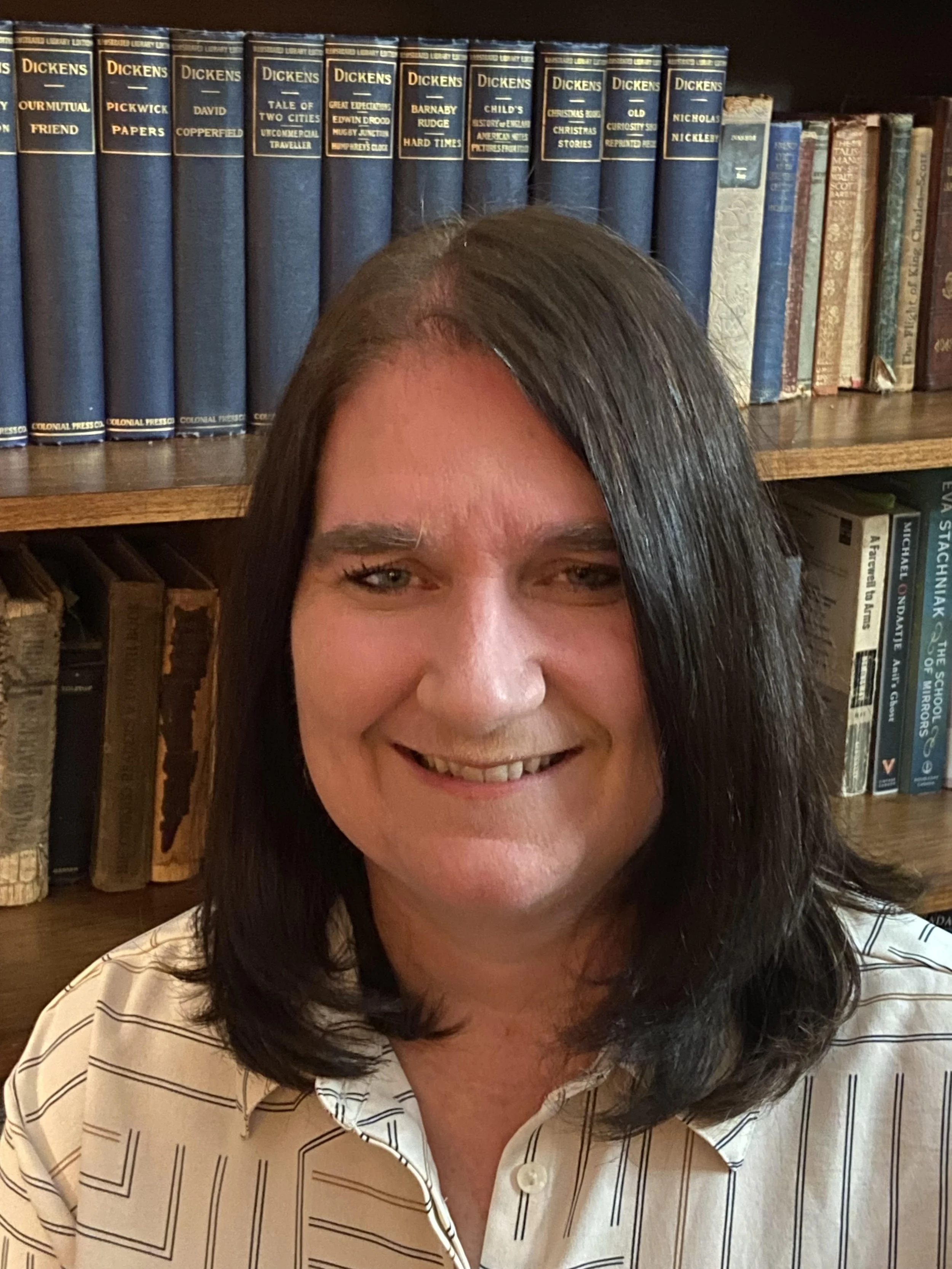
bonnie day
is a high school English and history teacher in Ottawa, Canada. She has been published in Beyond Words Literary Magazine and the Avalon Literary Review. Despite life’s fragility, she has found hope and happiness through the little things in life—the feeling of wind against cheeks when cycling, voices raised together in song, or holding a hand through the tears.
In memory of Karl Mann.