
Dream Girl
victoria krammen butler
Thunk… Thunk… Thunk. She flipped through the stack of records on the low shelf, her fingers passing one after another. Thunk… Thunk. She didn’t register the titles. The faded covers and curly letters blurred, and each pass wafted a quick puff of stale air onto her wrists. She finished one bin and repeated her movements with the next.
She’d been in the record store for nearly an hour, while her feet grew hot in her leather boots and the straps of her overalls tugged at her shoulders. But she had a good feeling about the day. She wasn’t even sure if there were other ways she could feel about a day. Record stores were an easy place to strike up a conversation – rarely was there much else vying for people’s attention, and hunting for an album was a good jumping off point. She preferred not to initiate, however. Not that there was any rule against it; she’d approached the men plenty of times. It simply felt less contrived if they approached her. And that was one of the rules – one of the kernels deep in her brain that she simply knew and was sure of. It had to happen naturally.
She scanned the sunken room and its hip-height rows of albums, measuring its potential again. A young man in a black beanie with colorful tattoos up both arms, tapping his foot while he rifled through records. Confident. A gray-haired businessman with a gold wedding band, smiling as he plucked at jazz albums. Happily taken. A 30-something skater, fidgeting with his board at the top of a short flight of stairs that led to the registers and front doors. Gone.
The current crowd was not promising. And, yet, her day wasn’t over. Just outside this door, Haight Street was crowded with shops and cafes, each with opportunity.
Her mind drifted to a different morning – a week ago – when she’d woken up in a double bed under a naked duvet. She’d had that familiar, slight-foggy feeling in her brain, and the mattress was different. So, unhurried, she looked up at the ceiling first, as she always did when she knew she was in a new location, and took in the remnants of an ornate chandelier rose. Then, propped on her elbows, she’d scanned the room. The bed was pushed up against closed french doors. A closet door to her right was ajar, held open by a tumble of boots. The room itself was furnished with only a black dresser and desk, its Edwarnian walls a pale yellow – a shade that could be intentional or the result of neglect. Clutter covered every surface: books, albums, crystals, tangled chargers and cords, a discarded denim jacket. An old radiator gurgled next to the bed.
Her next practiced task was to check for injuries or bodily anomalies, so she’d thrown off the duvet and swung her feet onto the thinly-rugged hardwood. Nothing of note this time, except a single tattoo on her left forearm: two dahlia buds, balled and draped over one another. Satisfied, she followed her instincts down the narrow hallway to the bathroom. There, as she looked in the mirror, she’d run her fingers through her hair. Her face was always the same but the bleached-white streak in her shaggy brown bob was a nice touch for this…story. That’s what she’d settled on calling them – these lives she lived for a few weeks or months. She’d opened the medicine cabinet to find an expected assortment of painkillers, barely-used vitamins, sunscreen, toothpaste and a bottle of Adderall. One time, a before time – in a wholly different medicine cabinet – she’d found antiseizure medicine and appointments on her calendar with a neurologist for a traumatic brain injury, which had been interesting. Another time, she found beta blockers.
Problems of the heart were surprisingly effective to do the job, even if metaphorically blunt.
Finished with her inspection, she’d made her way back down the hall and into the small front parlor that abutted her bedroom. There, plants took up most of the space, those behind the couch tickling her neck as she bent over her phone (found in a slouchy purse on the floor). Her calendar showed shifts at an animal shelter on Florida Street, San Francisco. Her ID, inside a vintage cigarette case, had the name Mia Lennox, born 1997, and an address on Central Avenue. When she read the name, memories of coworkers, commutes, and estranged parents rushed in – not one at a time, but as a wave. It was always like this, a feeling of self-assuredness accompanying the details. She could still sense whispers of the weeks, months and years she’d experienced in stories before, but she never longed for them. That was another rule: she should remain in the present. The fragments were enough to know she existed, and that in itself was all she needed. She liked it that way. Though, again, she wasn’t sure if there even were other ways.
She cracked her neck, mentally back in the record store. She’d only visited the few blocks closest to her apartment so far. As she turned toward the store exit to leave, a young man sidled up next to her. Pulling out a weathered album, he huffed under his breath. It was as good an invitation as any.
“Find something good?” Mia asked.
“Violent Femmes,” he answered. “One of my girlfriend’s favorites.” He shrugged one shoulder.
“Ah, a classic choice,” she nodded. She knew he wasn’t it. It was extremely rare to connect with someone already attached. That typically got in the way of the sort of whirlwind, carefree epiphanies she needed them to experience. She didn’t do love triangles.
The man smiled politely, then stepped around Mia to continue down the row. As he moved, she noticed a second man had walked into the aisle. He reached for the records, shifted one in the stack, then put his hands in his pockets. Rocking on his heels, he reached out again, but changed his mind halfway through and adjusted his black-framed glasses instead. He looked like he’d just come from work, with an unironed button up tucked into jeans.
“What are you looking for?” She took two steps in his direction.
“Uh. I don’t know. Are these the only Fleetwood Mac you have?” He looked up at her with green eyes. He was handsome, in a ruffled sort of way. He probably spent a lot of time in his head, too preoccupied to care about appearance. A good sign.
“I don’t work here,” she answered with a lopsided smile. “But I could help you look?” “Sorry, I didn’t mean…”
But Mia was already reaching under his arm to shuffle through the bin. The songs came to her, and she hummed Dreams as she flipped.
“I saw Stevie Nicks play once, you know?” She peered up at the man over her shoulder. “I don’t even remember how I ended up there, but she threw me one of her guitar picks. Still have it.”
He made eye contact briefly, searching. “Oh?”
“I also had an Uncle who swore that the band was better before Stevie Nicks joined. He was adamant about it. But,” she drawled, “I’ll wait to gauge your reaction before I tell you that I wholeheartedly disagree.” She was entertained at the words coming out of her mouth. Perfectly idiosyncratic. Hitting all the right notes from the playbook that existed within her.
“I don’t know anything about that.” He held up a hand in surrender, the corners of his lips tugging.
“So, you’re a fan then?”
“Yeah, I mean, it just seemed like a safe bet.”
“Do you usually go for safe bets?” She stepped back so she could face him.
“Usually?” he snorted. “Yeah. But look where that got me.”
“What do you mean? You’re here.” Mia was proud of her optimism. One of her most useful qualities, she knew.
“Yeah, shopping for records at 1pm on a Thursday is a real sign of success. No offense.”
He shook his head. “I mean, I was laid off today. And now I’m here. As you pointed out.”
“That’s a shame.” Jackpot. Textbook, even. Here was a guy for her. A guy who needed the push that she was primed to give.
“Yeah, well. That job was supposed to be a ‘safe bet.’” He air quoted the phrase.
Mia spun back toward the records and snatched one of the copies of Rumors.
“Here,” she said, pressing it to his chest. “Something safe…” She grabbed his elbow and began dragging him down the aisle. “And something new!”
She tugged him along behind her, his long legs keeping up and winning out against his inhibitions. They turned the corner to the blues albums.
“Hmmm, probably too on the nose,” she declared, moving them along with an exaggerated frown.
They passed through aisle after aisle, holding albums up for each other to approve, but not landing on anything. At least he was truly smiling now. That was quick.
“I have it!” Mia shouted. They were standing in an aisle with funk and disco. “Donna Summer. You literally cannot be sad listening to this. It’s a rule.”
“I’ll have to trust you on that.” He took the album from her, and he fidgeted with the corners.
His selections confirmed, they walked up the stairs and toward the registers at the front of the store. Once there, he stopped and turned to her.
“Thanks. Um…”
She could see the gears turning behind his eyes. Would he ask? This was heading in the right direction, and she could give it a friendly nudge.
“I’m Mia, by the way.” She stuck out her hand. “Glad I could be of service. Maybe I should get a job here?”
“Mia.” He studied the name as he grasped her hand in a shake. “I’m Jacob.”
“Well, Jacob, it was a pleasure.” She let her fingers linger before she spun toward the front door.
“Hey, actually,” he called after her as he swiped his card to pay. She turned to face him. “I’d, uh, can we hang out sometime?”
“We can hang out right now.” She smiled. This would be fun. Who was she kidding? It was always fun. “I don’t have anywhere to be. You don’t have anywhere to be. The afternoon is young!”
Jacob chortled before following her onto the busy sidewalk, his bagged records under his arm. Outside the doors, Mia spotted a row of heavy black bikes locked in their metal dock. She untucked her phone from her back pocket and paid for two rides, while Jacob watched, puzzled. She pulled the first bike from its metal hooks.
“Here.” She proffered the handlebars in his direction. He looked between her and the bike as if she’d handed him a live animal.
She gave it no mind. He’d follow. They always followed. She removed the second bike and swung a leg over, kicking off without looking back.
He did follow. She led them away from the stop-and-go of Haight and chased the cars headed toward Golden Gate Park. She needed space to work. Or, rather, for him to work. She wasn’t in charge here – she was just a guide.
Glimpsing some lawn between stands of eucalyptus and cypress trees that bordered Kezar Drive, Mia turned onto a path that brought them off the thoroughfare. The sound of airbrakes and engines now dampened by the trees behind them, she could make out muffled music ahead.
Jacob pulled up next to her on the wider path. His forehead glistened slightly, and he was breathing heavily.
“Where are you taking me?” He was amused. And that was amusing to her.
“An adventure.” She laughed and sped off around a bend. Another rule: embrace spontaneity.
The path opened up into a sunken meadow. Busy roads ringed the park, but here she only saw neon grass, towering trees, and a playground teeming with preschoolers. Fog licked the treetops to the west, making the open sky seem stark.
To her left, a group of adults was gathered on a hillside. Scattered blankets quilted the grass where most of them sat or leaned back on elbows, their legs outstretched under the afternoon brightness. A few had drums in front of them, and others danced – a cacophony of swaying, twirling. Mia rode to the edge of the gathering. She laid her bike on the grass and stretched her arms wide, spinning on the spot, her face tilted to the sky. Like every time, it felt like the right thing to do. Her feet didn’t feel so hot inside her boots anymore. When she stopped, Jacob stood next to her, watching. He laughed nervously. With one hand, she scooped her purse and Jacob’s records out of their respective bike baskets. With the other, she reached out for his hand and she gave him a reassuring squeeze. His skin was warm and flushed against hers. She led them both deeper into the mass of flowered and striped blankets.
“I don’t dance.”
“Yes you do. Everyone dances.” She had stopped to face him and wiggled his arm playfully. “You just bought a disco record, so you better practice. Close your eyes.”
She nodded a greeting to the drummer sitting near her feet, and began swaying in time to the beat. Jacob didn’t close his eyes, but he did start bouncing gently. His smile creased the skin next to his eyes. More ruffled and more handsome now.
This was always the most challenging part – teaching them it’s ok to simply give in. But she enjoyed it. Yearned for it, even, in those days she spent alone waiting for a new man. The fire usually caught slowly, over days and weeks. But she needed to create a spark quickly; she needed them to be intrigued just enough. Without that, she’d lose them. Or so she assumed, since that had never actually happened.
She needed Jacob closer.
She tugged at his arm, and he lurched forward, perfectly situated for her hands to settle on his waist. It was difficult to move his body for him, but she eventually coaxed his hips into a tight figure eight, while her fingers tangled to untuck the hem of his shirt.
“Loosen up. You can’t overthink it,” she said, giggling. He laughed, too, and
over-exaggerated the moves. They settled into something that felt shared: Mia easy and flowing, Jacob unsure but following her lead.
The drums didn’t form a song. There was no chorus or bridge, no breaks or pauses, just
the seamless flow of beats from one pattern to the next. If she wasn’t listening for it, she couldn’t even notice when one rhythm became something different. They danced until they were sweaty, and Mia finally flopped down onto the grass where they stood.
The drummer leaned in their direction, and he held out a tightly-rolled joint. She thanked him and introduced herself, then gestured for Jacob to join her on the grass. Mia inhaled once, then again, before offering it to Jacob. Like a record store, a little innocuous drug use was a tried-and-true, classic ingredient for inspiration. He hesitated, and she encouraged him with a gentle elbow to his ribs. She left her arm resting against him; her eyes followed his lips as they relaxed around the tacky paper.
Letting the weed settle in, she leaned back on her elbows and looked toward the stretch of grass at the bottom of the hill. A man stood there over a giant dish of water holding two broomsticks, a circle of thick rope strung between them. Mia watched as he lowered the contraption into the water, then slowly lifted out a giant bubble, stretched by the breeze until it was the length of a small car. The bubble tube wobbled over the grass, and she held her breath, waiting for it to pop. It did. The man pulled out another, over and over, to the delight of the families that had wandered over from the sprawling playground further down the meadow.
She felt her senses slowing. Her focus homing in on the shape-shifting bubbles that lasted mere moments. Her lives – her stories – felt just as ephemeral. She didn’t exist from city to city, or life to life. For all she surmised, those women with her face and different hair and different jobs and intriguing medical conditions and uncomplicated outlooks didn’t last. She wasn’t a long-term fixture. She wasn’t meant to be.
“Tell me about this job.” Mia used her leg to nudge Jacob, who was now reclined beside her, his eyes following the creeping fingers of high fog that threatened to create a canopy over their meadow.
“There’s not a lot to tell. It’s all pretty cliché, honestly. I moved here because an old college buddy started a company – that was just under a year ago. You know, American Dream sort of stuff. Engineering. I thought if I could get in on the ground floor of a startup, then we’d sell, I’d make a ton of cash, I’d have my own lightbulb moment, I’d start my own company.”
“So what happened?”
He breathed, slowly in, out. “We did get acquired. We’ve been celebrating for a month and tying up all the loose ends for the deal. But they just wanted the tech we’d created. We’d only closed the deal a couple weeks before the new company laid most of us off – the original staff. All that work for nothing.”
“That doesn’t seem fair.” Mia twisted blades of grass between them. It really didn’t seem fair. She stilled.
Jacob shrugged. “I should have seen it coming. I feel like an idiot now. Picking up my whole life. And for what? A guy I went to school with who swore he needed me. But when push came to shove…”
“You got the shove.”
“Right.” They were quiet for a few minutes, staring off into the distance, sinking into the cool grass beneath them. “And now do I stay?” Jacob seemed to be talking to himself, the words thick. “Do I find something else here, where the same thing will happen, inevitably? Or do I move back to Chicago, where at least it’s not such a bubble. I swear, if I have to ask my parents for more money…” He sat up, flushed. “Sorry. I don’t know why I’m dumping this on you. I just met you. I…let’s…we can talk about something else.”
“It’s ok. I don’t mind listening. What about your lightbulb moment? Anything turn on?” She needed a kernel to work with. The rest was just a distraction.
He shook his head. “What about you? How long have you been in the city?”
Mia sat up to meet him. That was fine. She’d done this before: helping them realize that
the idea was already there, even if they couldn’t see it yet. The introspection. The self-doubt. The loneliness. The potential. It was right there with Jacob. It would just take more time.
“Oh, not too long. A few months now,” she told him. It was both true and untrue, her life filling in the gaps as she said it. “My apartment’s just over there,” she pointed indiscriminately back toward the traffic, “and I work part time at the SPCA.” After a beat, she added: “Are you a dog person or a cat person?”
He narrowed his eyes. “Trick question? What if I say both?”
“I’d say that’s a safe answer. I’m partial to senior dogs, personally. They become so sweet in their old age. It’s a shame more people don’t adopt them.”
By this point, the fog had thickened, the milky ink of it eclipsing half the circle of sky above their meadow. Mia checked her watch – three o’clock – and rubbed her bare arms in the noticeably wetter air.
“You’re cold,” Jacob said. He tugged at the legs his pants, making to stand up. “We can go before the fog rolls in.”
“We don’t run from a little fog.” She smirked and pulled a spare cardigan out of her purse. “We chase it.”
She sprang to her feet and pulled Jacob up, too. With a quick thank you to the drummer, she was back to her bike and coaxing Jacob along.
They spent the next hour meandering toward the coast: down JFK Drive, past the Conservatory that reflected the fog on its bright white turrets, past the de Young Museum with its harsh, dark lines and unbalanced tower. He bought them pretzels from a old man pushing a silver cart. She picked him a creamsicle nasturtium from the banks of Hellman Hollow. They kept going, following the road, the paths and trails turning from rocks to packed dirt to sandy soil.
And Mia found herself at the end of the world. The gnarled cypress trees of the park parted to make space for open sky and tumbling waves of the beach, and the road nearly dumped them onto the lumpy sand. Mia rolled her bike over the rough cement, crumbled in the salty air, and Jacob followed. After locking the bikes into a pay station and collecting their belongings, they wobbled to the shore, their legs tired and unsteady.
She flopped down, and Jacob sat so close to her now that his shoulder brushed hers, their hips sinking toward each other as they settled on the beach. Mia looked out onto the waves – the water so gray in the afternoon fog that there was no seam between it and the horizon.
“So small,” she whispered.
“What’s up?” Jacob asked, leaning close to her ear to be heard over the ocean’s roar.
“Oh, just, I always feel so small when I’m at the coast like this. It’s been a long time. I’ve missed it.” The realization surprised her.
He cocked his head. “I thought you’d been here a few months now – you never come out to the ocean? It’s one of my favorite places to think.”
Mia didn’t have any memories of this beach.
“What do you think about when you come here?” she prodded, attempting again to stoke a spark and return to what she was good at.
“I’d assume it’s the usual stuff people think about – am I doing what I love, how long has it been since I called my mom, how many sharks are right there in the water.” He laughed as he pointed to the waves. “You know, normal stuff. What about you?”
“Well, you know, normal stuff: who makes our choices, and do they even matter? Will anything I’ve touched last?” She attempted blasé.
“Where did you come from?” He grinned and leaned back on his hands to take her in. At least it got the right reaction.
“Everywhere and nowhere. Same as anyone else.”
It wasn’t a lie. She didn’t actually know who she was before. Or if there was a before. Did she want a before? She pulled at those wisps of memories that always tickled the back of her mind and she brought forward images from the first time she woke up. She had been sitting in a crisply-upholstered wingback chair, wearing a silk chemise and oversized fur housecoat. She’d opened her eyes to a deep purr at her side from a pet jungle cat – truly. And she knew. There was no physical instruction manual or guide; it was instinct. Like a light switch flipped on. She was here as a catalyst. Her role was simple: exist for him. Be his push. Inspire him to reach higher, to discover new meanings of life. And, when he did, she would move on and do it again. There was no fear or question or sense of missing. Just unending confidence that she had a purpose.
“But we’re here now,” she offered to Jacob next to her, swallowing hard. “We’re here now.” He nodded, as if that settled it.
The sky grew darker as the sun began its descent somewhere they couldn’t see behind the fog. Mia stood abruptly and began dusting off her pants.
“It’s getting late, huh?” Jacob stood up next to her and brushed his legs and arms, too. “Yeah, no. I just don’t want to ride the bus back in the dark.” She felt the need to know where she was.
“We could Uber together?” They turned their backs to the waves and began laboring through the uneven sand.
“It’s ok, really. I like the bus.” Her fingers brushed his. They were cool and dewy, the misty air sitting on his skin. Hers felt clammy.
“Can we hang out again?”
Success, she told herself. She was only feeling off because she was anxious to know if this was clicking.
“Give me your phone.” They were almost to the road now – the cars’ humming on the pavement competing with the crash of the ocean. The letters shifted under fingers as she tilted left and right, trying to steady herself on the soft beach. “There. You have my number. Text me, and I’ll save yours.”
They reached the road, and Jacob turned to her. “My Uber’s over there.” He’d called it while they walked, it seemed. “I’ll text you. Get home safe, yeah?”
“You too, Jacob.”
Before the moment could pass, Mia took hold of his arms and raised onto her tiptoes. She felt his warm breath on her forehead as his hands wrapped around her elbows, his bagged records bumping her hip. She lightly kissed his stubbled cheek. He smiled down at her, an eyebrow lifted. Mia lowered herself back onto flat feet and strode into the crosswalk that would take her to the right bus.
Casually, she looked back over her shoulder. Jacob stood watching her with a curious smile.
She waved.
~~~
Mia woke up the next morning still in her bed in San Francisco, still staring up at that same chalky ceiling rose. She smiled to herself, because that meant he would call.
But he didn’t call. Not that day, or the day after. Or the day after that.
If she’d already given Jacob the push he needed, she would have woken up in a new room, in a new city, with a new life. And she doubted that was possible anyway, since she’d spent less than 12 hours with him.
There had been a spark, she was certain. She’d definitely captured his attention. And he said he would call. That meant he would.
So, Mia waited for him.
Each day, she showered and dressed. She padded to the fridge. She ate what was there. She dismissed that little nag in the back of her mind. She sat on the couch. She watched her phone. Patient. She knew the routine.
~~~
On the fourth day, the food in the fridge dwindling, Mia decided she should venture to the grocery store.
As she laced her boots, she reminded herself to focus and make this trip quick – she didn’t want to miss Jacob’s call, after all. She had to be ready if he asked to meet up. That was her job, and she couldn’t afford any mistakes. Or another mistake? Had she already made a mistake somewhere and this was the consequence? No. She breathed deeply, steadying herself against her door frame. The men always called. She always heard from them again within a few days. Three max. Which meant it had to be today.
So she took a car and hurried through the aisles, returning home to keep vigil.
~~~
On the fifth day, Mia woke again with a view of the ceiling rose, its peeling paint mocking her. She decided a trip to the record store was in order to get back on track. Maybe he lost her number and was looking for her too. She got ready and arrived outside the locked doors 10 minutes before opening. The wet air filtered the sunlight and turned everything around her a lumescent gray. She tapped her foot against the concrete. Waiting.
Once inside, she wandered the aisles. She stood in the corner watching the door. She went to the bathroom. Then made the rounds again. Finally, an employee approached and asked if she needed any help.
“Have you seen a guy here in his late 20s, shaggy brown hair and black glasses? He likes Fleetwood Mac. About this tall?” Mia held her hand up above her head. She felt…ridiculous, she realized. Desperate even. Was this who she’d become?
The employee shrugged. Mia apologized and jittered outside.
She stretched out the short walk back to her apartment, kicking the litter on the sidewalk as she ticked through her tangled thoughts. Where she usually felt compulsions to take action, she felt only questions. She was sure now that she had done something wrong with Jacob. But what, and how could she fix it? She thought back to their conversations. She’d asked him all the right questions; prompted him in all the right places. Embrace the adventure, she’d encouraged; or what about your lightbulb moment? She’d also told him it wasn’t fair. And she meant it. She’d meant it with more conviction than she’d ever felt. How could that be wrong?
She was almost home, but she turned right instead of left; she didn’t want to sit on that couch anymore.
Under a blanket of gray sky, a new question came to her: what would happen if he didn’t call? If this life was no longer tied to…She shook it off. She wasn’t going to go there. There were anomalies, she assumed, because no system was perfect. She could fix this.
She passed a discount store a few blocks out of the way, where dozens of shoes and purses stacked in the window caught her attention. Cheap fairy lights weaved over and around the boxes and bags. She had bought new attire before out of necessity – a sudden rainstorm that required a jacket, for example – but she’d never bought new apparel out of desire. Not in any story. She didn’t make decisions like that. She felt a slight prickling in her limbs and stomach, a heightened awareness of her surroundings.
The display was beautiful and magical and so simple. She stepped into the store.
The overhead lights glared, contrasting sharply with the gray morning. She blinked rapidly, adjusting. They spotlighted the space and shelves – the choices – around her. It all felt endless, but not in an overwhelming sort of way. It was just another adventure, she told herself, and she was good at adventures. Even if she’d never had one for her own benefit.
She wandered the haphazard space and ran her hands delicately, intentionally over the options, studying each one: thick-soled walking shoes, heavy work boots, strappy high heels, bejeweled pumps, thin sandals, chunky sandals. So much potential on the shelves.
Her fingers rested on smooth canvas that formed the clean lines of a basic tennis shoe. She pulled the box with her size from beneath the display and carried it to the register at the back of the store.
She finished the walk home with new white shoes on her feet.
~~~
On the sixth day, she woke and picked her phone up off the bedside table. Its black screen stared back. She’d forgotten to charge it overnight. She tossed it onto the bed, still unplugged, and covered it with her pillow.
After an indulgent shower, her skin still sticky, she dug into the overstuffed closet full of dark and heavy material that suited Mia. She shoved leather and denim aside and reached to the corner of the closet hidden from the light. Her fingers found something smooth – almost slippery. She carefully brought it forward, weaving through the other hangers. A silk skirt. The dark fabric teemed with flowers and vines, and she put it on with a t-shirt she found in a drawer.
She felt lighter.
She lifted her purse from the top of the dresser, slid into her new shoes, and left through the front door of her apartment.
Outside, she found a bike rack halfway down the block. Without her phone, though, she couldn’t pay. So, she walked. Up a few blocks to Kezar Drive, onto a path into Golden Gate Park, past the Conservatory, past the de Young, past the pretzel and ice cream carts. She didn’t notice other pedestrians or joggers or bikers on the concrete. There were no drums in the distance.
She only stopped when she reached the beach. Sweaty, despite the cool air.
The waves shone silver and deep blue in the morning sun, and fine grains filled her shoes
as she ventured onto the sand. She followed the soft brown peaks and valleys as they flattened to a smooth surface under the break of the waves. To her left and right, low mist swallowed the beach, blurring it into oblivion. Her world had shrunken to this tiny pocket of coastline.
And she realized it was just her. This walk. This beach. This day. She left alone and arrived alone.
Something nudged her foot. She looked down to see a neon tennis ball flecked with wet lumps. A yelping bark followed, and she watched a giant, ugly dog hurtle toward her through the fog. The dog shook its wiry fur; it only had three legs, and she laughed to watch the tripod wobble but stay upright. The dog quirked its head at her and yipped.
She bent down to reach for the ball, and a soft voice behind her made her jump.
“Sorry about her,” the voice said. A woman with a tangle of dark, wet curls walked around to stand beside the dog. She was wearing a rolled-down wetsuit for pants, and she gave the animal a rough scratch to its side. “She’s harmless, really. Down a leg, but she makes up for it in confidence.”
“What’s her name?”
“This is Tipper. She likes to watch while we surf.” The woman gestured to several people waxing boards 100 yards away. The fog had shifted to expose their group on the beach. “But her favorite is making new friends.”
Tipper yelped again, her wagging tail threatening to pull her sideways.
“Hey, your shoes are getting wet,” the woman added.
“Oh?” She looked down. She was standing at the water line, the waves rolling over her shoes. “Yeah, I…whoops.” She stepped out of the way of the ripples.
“I’m Asha.” The woman held out her hand, her fingers sandy. “I’m sure someone has an extra pair of sandals, if you want them while you dry out.”
“That’s ok. I’ll be ok.”
Asha bent to pick up the ball, tossing it back toward her friends. Tipper chased it at full speed. “Are you sure? You don’t want blisters to ruin the rest of your week.”
The rest of her week. The rest of her week. “If it’s really no trouble.” She huffed a laugh and felt a strange sensation in her stomach. Not the prickling uncertainty she felt before. No, this was something looser and alive.
“It’s nothing,” Asha began walking to the group, beckoning her to follow with a nod. “What’s your name, by the way?”
She pushed up the sleeves of her shirt to steady her shaking hands, her fingers brushing the tattoo. The buds had opened. Two large dahlias unfurled across her forearm.
She — somehow — had found a small crack, she realized. Perhaps a way out. Or a new way forward. She knew who she wanted to be.
“Dawn.” And it’s real.
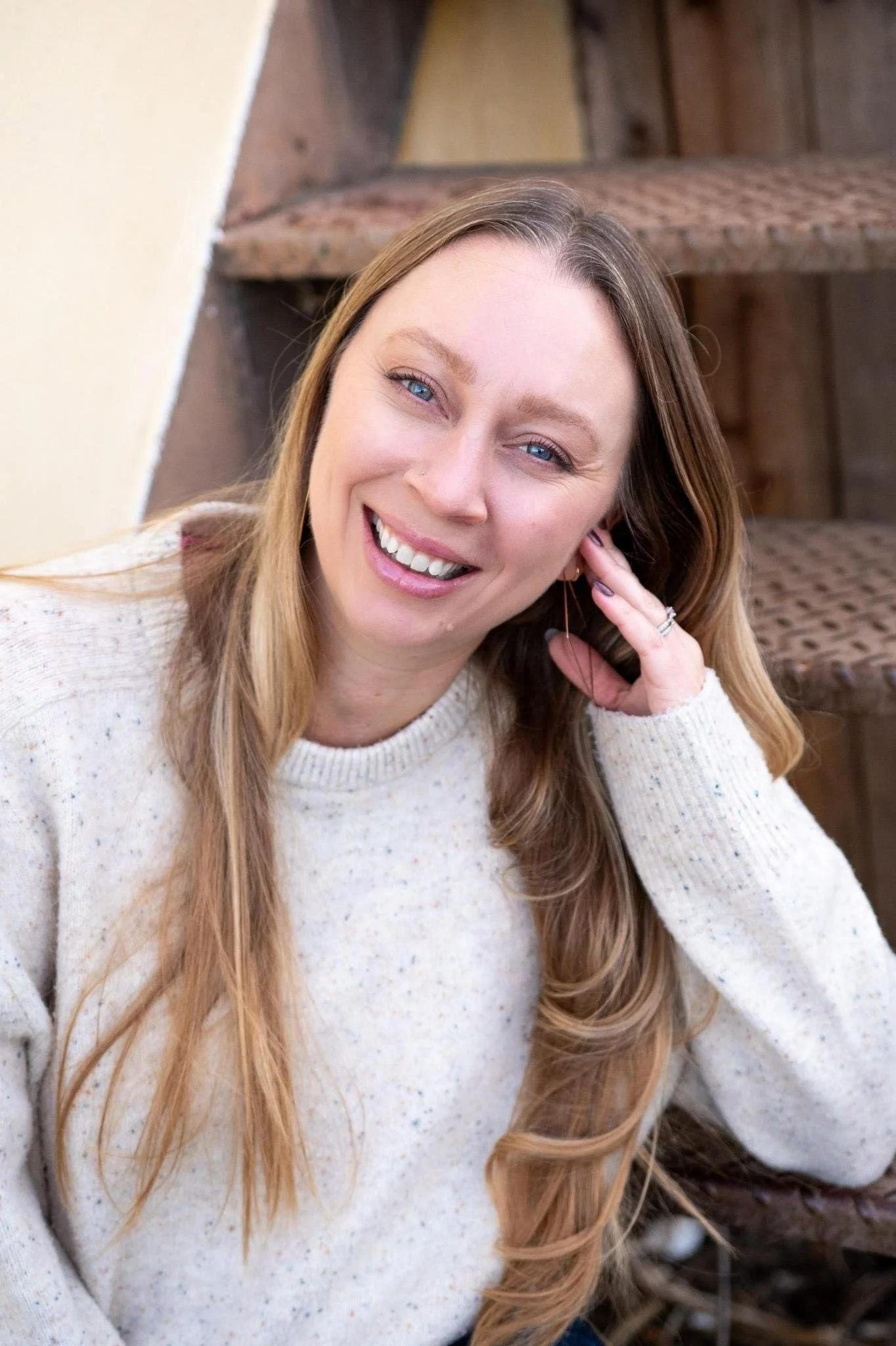
victoria krammen butler
studied journalism and English literature at San Francisco State University, where she learned to love stories that question the way we see the world. Born and raised in the Bay Area (and still there), she now works in Public Relations while carving out time to write amid the chaos of family life and perpetually-expiring Libby holds. You can pry the em dash from her cold, dead hands.